
Which vehicle needs servicing next? Who books the work? What budget should you allow? Preventive fleet maintenance starts with these answers. Follow four steps to schedule servicing and checks based on mileage, elapsed time and vehicle condition, then track tyres, costs and due dates.
Organise maintenance in 4 steps
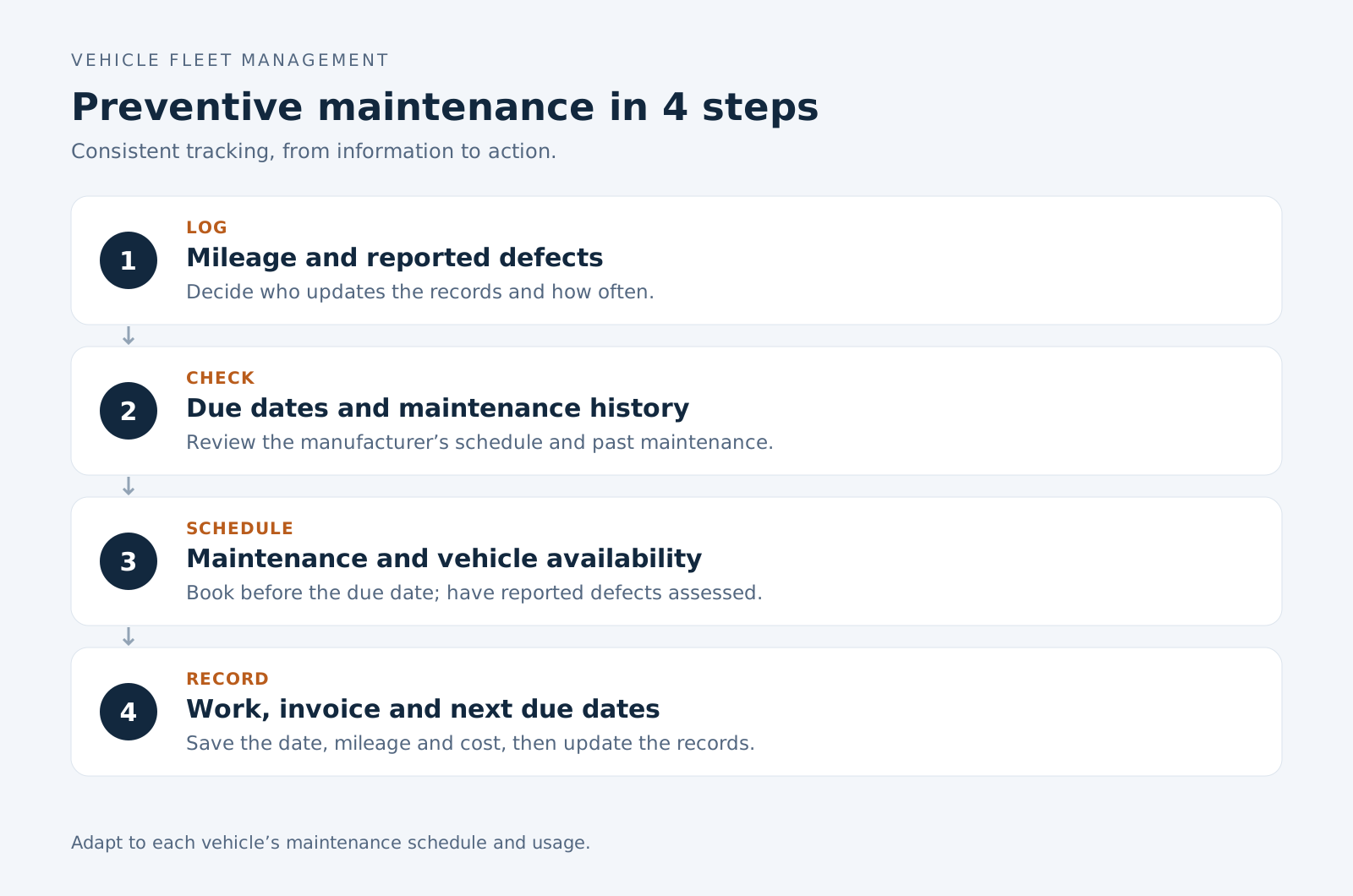
- Log mileage and defects. Decide who updates the records and how often. A reported noise, warning light or fault should be assessed without waiting for the next service.
- Check due dates. Cross-check the manufacturer's schedule against past maintenance: oil changes, filters, belts, brakes and tyres. Include roadworthiness tests and inspections specific to your activity.
- Schedule the work. Book before the due date, accounting for vehicle usage and whichever comes first between date and mileage.
- Record the work. Keep the date, mileage, work completed, supplier and invoice. Update the next due dates.
Fictional example: a van has 78,000 km on the clock and needs servicing at 80,000 km or in December. The manager estimates when the first threshold will be reached and books accordingly. After the service, they record the work and its cost, then update the next due date using the vehicle's schedule. These figures illustrate the method; they are not maintenance recommendations.
Tyre maintenance for a vehicle fleet
Tyre wear depends on factors including load and journeys. For each vehicle:
- Check pressure and condition following the manufacturer's recommendations, with an assigned person and frequency.
- Measure tread depth. In France, the main tread grooves on passenger cars and light commercial vehicles must retain at least 1.6 mm (Article 5 of the Order of 18 July 2019, in French). Have a professional assess tyre condition to plan replacement.
- Have uneven wear examined: it may indicate an alignment or suspension problem.
- Log replacements: date, mileage, reference and cost. Also plan seasonal equipment appropriate to your region.
Track maintenance costs
Separate preventive spending from corrective repairs. When comparing vehicles, account for age, usage and distance travelled.
A simple indicator: maintenance cost per kilometre = maintenance spending ÷ distance travelled over the same period.
An increase in corrective work warrants investigation: ageing, intensive use or delayed maintenance may contribute. This history helps with budgeting and assessing repair or replacement options alongside vehicle condition.
Make due-date reminders reliable
A useful reminder combines a date or mileage threshold, an up-to-date odometer reading and an assigned person. Allow enough time to book the work before it is due.
A shared spreadsheet can work, with automated reminders if needed. A dedicated tool becomes useful when information gets scattered or several people handle the tracking.
MotorTrack: today and what comes next
MotorTrack brings maintenance events and defects together for each vehicle, making it easier to find the history and prepare upcoming work.
Our goal is to build more complete preventive maintenance support for Fleet: automated reminders, assigned owners, cost indicators and detailed tyre tracking. These are areas for future development, rather than features that are all available today. This article describes the approach we are working towards with MotorTrack.
Discover how to query your fleet records in natural language.
Looking for a tool to organise your vehicle records? Explore MotorTrack Fleet and its current features →